Modern Periodic Table Metals Nonmetals Metalloids : Which period of the periodic table (a) has no metals? (b) has no nonmetals? (c) has one post ... / The chemical elements can be broadly divided into metals, metalloids and nonmetals according to their sh
Modern Periodic Table Metals Nonmetals Metalloids : Which period of the periodic table (a) has no metals? (b) has no nonmetals? (c) has one post ... / The chemical elements can be broadly divided into metals, metalloids and nonmetals according to their shared physical and chemical properties.. Elements to the left are metals and nonmetals are to the right. Explore a column here, learn about a column there, with elements of the same column sharing similar properties. The chemical elements can be broadly divided into metals, metalloids and nonmetals according to their shared physical and chemical properties. As science advances, its laws become fewer but of greater scope. The elements can be classified as metals, nonmetals, or metalloids.
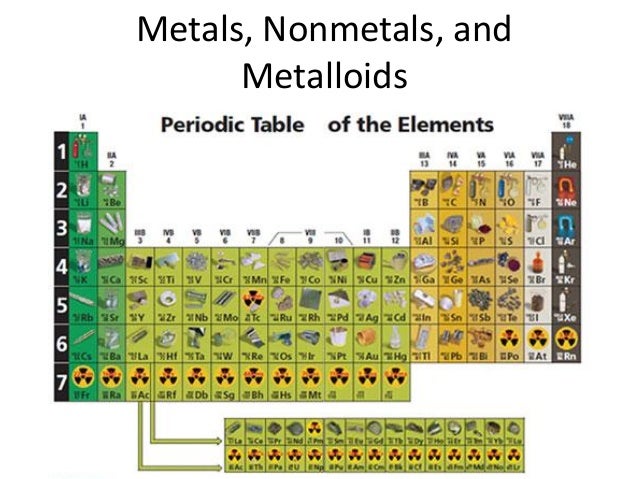
Using a periodic table, determine the chemical symbol from each of the eight elements to be tested in this laboratory. See descriptions of the properties of these major metalloids have some of the properties of metals and some nonmetallic characteristics. However, the modern periodic table of elements follow the law that, the properties of elements vary according to their. Students will be able to compare and contrast metals, metalloids, and nonmetals in the periodic table. The periodic table of the elements with metallic elements colored in green, nonmetallic in orange and metalloids in blue.
Characteristics Of Metalloids On The Periodic Table | Brokeasshome.com from image.slidesharecdn.com In this article, we shall concentrate on the metalloids from the periodic table. Unlike metals, which typically form cations and ionic compounds (containing ionic bonds), nonmetals tend to form anions or molecular compounds. As science advances, its laws become fewer but of greater scope. Nonmetals are primarily listed on the right side of the periodic table and have more of the opposite attributes of a metal. Explore the physical and chemical properties of eight elements with the goal of classifying them as metals procedure: Metals are good conductors of heat and electricity, and are since the metals are further to the left on the periodic table, they have low ionization energies and low electron affinities, so they lose electrons. The elements commonly recognised as metalloids namely boron, silicon, germanium, arsenic, antimony, and tellurium have predominately nonmetallic chemistries, so you could count them as nonmetals too. The metalloid group separates the metals from the nonmetals.
Some scientists call metalloids poor metals or.
The transition metals make up groups three through 12 back in the main body of the periodic table. The exception is the element hydrogen. See descriptions of the properties of these major metalloids have some of the properties of metals and some nonmetallic characteristics. Elements in each class share certain basic properties. Metals are excellent conductors of electricity and heat. There are total of 102 metals in periodic table. The chemical elements can be broadly divided into metals, metalloids and nonmetals according to their shared physical and chemical properties. The metalloid group separates the metals from the nonmetals. Using the periodic table to identify metals, nonmetals, and metalloids. Metals, nonmetals, and metalloids are three classes of elements. Metalloids can also be called semimetals. They have properties of both metals and nonmetals. Periodic table (metals, metalloids, nonmetals).
Metals are excellent conductors of electricity and heat. Metalloids come between metals and non metals. Metalloids can also be called semimetals. They are electronegative in character. What type of element is iron?
PPT - The Modern Periodic Table Chapter 6 PowerPoint Presentation, free download - ID:5175667 from image2.slideserve.com Reactivity is how likely an element is to react chemically with. Explore a column here, learn about a column there, with elements of the same column sharing similar properties. The periodic table of the elements with metallic elements colored in green, nonmetallic in orange and metalloids in blue. Look up chemical element names, symbols, atomic masses and other properties, visualize trends, or even test your elements knowledge by playing a periodic table game! As science advances, its laws become fewer but of greater scope. It's hard to believe, but we've already navigated through a huge chunk of the periodic table. The modern periodic table now provides a useful framework for analyzing chemical reactions, and continues to be widely used in chemistry in chronological order, this section discusses metals and nonmetals (and metalloids); Metalloids can also be called semimetals.
On some periodic tables, you'll find a dividing line between metals and nonmetals.
Tables, periodicals and metalloids | researchgate, the professional network for scientists. The periodic table is organized into metals, nonmetals, and metalloids. Rows of the modern periodic table are called periods , as they are in mendeleev's table. Unlike metals, which typically form cations and ionic compounds (containing ionic bonds), nonmetals tend to form anions or molecular compounds. Metalloids can also be called semimetals. Elements to the left are metals and nonmetals are to the right. Reactivity is how likely an element is to react chemically with. Click on image for full size nonmetals, on the right side of the periodic table, are very different from metals. Once you can easily determine if an element is a metal, nonmetal, or metalloid you can then determine the type of compound. Metals are excellent conductors of electricity and heat. So far it's been pretty straightforward: The location of the representative metals is shown in the periodic table. The metalloid group separates the metals from the nonmetals.
The nonmetals are brittle, not malleable or ductile, poor conductors of both heat and electricity, and tend to gain electrons in chemical reactions. Explore the physical and chemical properties of eight elements with the goal of classifying them as metals procedure: What type of element is iron? Elements to the left are metals and nonmetals are to the right. See descriptions of the properties of these major metalloids have some of the properties of metals and some nonmetallic characteristics.
Modern periodic table|Groups and periods|Metals,Nonmetals & Metalloids - YouTube from i.ytimg.com Hydrogen has properties of a nonmetal at normal temperatures. The table lists all the elements that are currently known, in descending order of the number of protons that are present in a single atom of the element. It has luster like a metal, but is brittle like a nonmetal. Metalloids are more brittle than metals, less modern periodic table with group labels and chemical families identified fig 3.6. Reactivity is how likely an element is to react chemically with. The periodic table of the elements with metallic elements colored in green, nonmetallic in orange and metalloids in blue. The elements commonly recognised as metalloids namely boron, silicon, germanium, arsenic, antimony, and tellurium have predominately nonmetallic chemistries, so you could count them as nonmetals too. Click on image for full size nonmetals, on the right side of the periodic table, are very different from metals.
The further the metal is to the left side, and down, of the periodic table, the more reactive it is.
Metals are excellent conductors of electricity and heat. The chemical elements can be broadly divided into metals, metalloids and nonmetals according to their shared physical and chemical properties. There is a stair step through the metalloids showing the division. Silicon is used extensively in computer chips and. The elements can be classified as metals, nonmetals, or metalloids. They are electronegative in character. So far it's been pretty straightforward: Iron is a good conductor, malleable and magnetic. Metalloids come between metals and non metals. Once you can easily determine if an element is a metal, nonmetal, or metalloid you can then determine the type of compound. The exception is the element hydrogen. Periodic table (metals, metalloids, nonmetals). Metalloids can also be called semimetals.
The further the metal is to the left side, and down, of the periodic table, the more reactive it is modern periodic table. As science advances, its laws become fewer but of greater scope.


No comments:
Post a Comment